Franck Henry Pierre Ribéry is a French professional footballer who plays for German club Bayern Munich. He is a former France national team player. He primarily plays as a winger, preferably on the left side although being right-footed, and is known for pace, energy, skill and precise passing. Ribéry is described as a player who is fast, tricky and an excellent dribbler, who has great control with the ball at his feet. Since joining Bayern, he has been recognised on the world stage as one of the best French players of his generation. The previous talisman of the French national team, Zinedine Zidane, has called Ribéry the "jewel of French football".
Ribéry's career began in 1989 as a youth player for local hometown club Conti Boulogne. He left the club after seven years to join professional outfit Lille, but departed the club after three years after having difficulties adjusting. In 1999, Ribéry joined US Boulogne, where he played for two years. After spending two more years in the amateur divisions with two different clubs (Alès and Brest), in 2004, Ribéry earned a move to Ligue 1 club FC Metz. After six months with the club, Ribéry moved to Turkey in January 2005 joining Galatasaray where he won the Turkish Cup. After six months at Galatasaray, he departed the club in controversial fashion in order to return to France to join Marseille. Ribéry spent two seasons at the club helping the Marseillais reach the final of the Coupe de France in back-to-back seasons. In 2007, Ribéry joined German club Bayern Munich for a then club-record fee of €25 million. With Bayern, he has won four Bundesliga titles, four DFB-Pokal, one UEFA Champions League and one FIFA Club World Cup, which include three doubles and one treble. His form for Bayern in the club's 2012–2013 treble winning season saw him nominated alongside Lionel Messi and Cristiano Ronaldo on the three-man shortlist for the 2013 FIFA Ballon d'Or.
Between 2006 and 2014, Ribéry represented the France national football team 81 times. Ribéry has represented his nation at two FIFA World Cups (2006, 2010) and two UEFA European Football Championships (2008, 2012). He made his international debut in May 2006 against Mexico. At the 2006 World Cup, Ribéry scored his first international goal against Spain and played in the final match against Italy.
Individually, Ribéry is a three-time winner of the French Player of the Year award and has also won the German Footballer of the Year becoming the first player to hold both honours. He has also been named to the UEFA Team of the Year and declared the Young Player of the Year in France. In 2013, Ribéry won the UEFA Best Player in Europe Award. In 2013, he was also ranked fourth in The Guardian's list of the best players in the world.
Lionel Andrés "Leo" Messi is an Argentine professional footballer who plays as a forward for Spanish club Barcelona and the Argentina national team. Often considered the best player in the world and rated by many in the sport as the greatest of all time, Messi is the only football player in history to win the FIFA Ballon d'Or four times, all of which he won consecutively, and the first player to win three European Golden Shoes. With Barcelona he has won seven La Liga titles and four UEFA Champions League titles, as well as three Copa del Rey titles. A prolific goalscorer, Messi holds the Guinness World Records titles for most goals scored in La Liga (289), a La Liga season (50), a calendar year (91), a Champions League match (five), and most Champions League seasons (five).
Born and raised in central Argentina, Messi was diagnosed with a growth hormone deficiency as a child. At age 13, he relocated to Spain to join Barcelona, who agreed to pay for his medical treatment. After a fast progression through Barcelona's youth academy, Messi made his competitive debut aged 17 in October 2004. Despite being injury-prone during his early career, he established himself as an integral player for the club within the next three years, finishing 2007 as a finalist for both the Ballon d'Or and FIFA World Player of the Year award, a feat he repeated the following year. His first uninterrupted campaign came in the 2008–2009 season, during which he helped Barcelona achieve the first treble in Spanish football. At 22 years old, Messi won the Ballon d'Or and FIFA World Player of the Year award by record voting margins.
Three successful seasons followed, with Messi winning three consecutive FIFA Ballons d'Or, including an unprecedented fourth. His personal best campaign to date was the 2011–2012 season, in which he set the La Liga and European records for most goals scored in a single season, while establishing himself as Barcelona's all-time top scorer in official competitions in March 2012. He again struggled with injury during the following two seasons, twice finishing second for the Ballon d'Or behind Cristiano Ronaldo, his perceived career rival. Messi regained his best form during the 2014–2015 campaign, breaking the all-time goalscoring records in both La Liga and the Champions League in November 2014, and led Barcelona to a historic second treble.
As an Argentine international, Messi has represented his country in six major tournaments. At youth level, he won the 2005 FIFA World Youth Championship, finishing the tournament as its best player and top scorer, and an Olympic gold medal at the 2008 Summer Olympics. His style of play as a diminutive, left-footed dribbler drew comparisons with compatriot Diego Maradona, who declared the teenager his successor. After making his senior debut in August 2005, Messi became the youngest Argentine to play and score in a FIFA World Cup during the 2006 edition, and reached the final of the 2007 Copa América, where he was named young player of the tournament. As the squad's captain since August 2011, he led Argentina to the finals of the 2014 World Cup and the 2015 Copa América, and both times was selected as player of the tournament.
Andrés Iniesta Luján is a Spanish professional footballer who plays as a central midfielder for FC Barcelona and the Spain national team. He serves as the captain for Barcelona. Iniesta came through La Masia, the Barcelona youth academy, after an early emigration from his birthplace, and impressed from an early age. He made his first-team debut in 2002, aged 18. He began playing regularly during the 2004–2005 season and has remained in the team ever since. He was an integral part of the Barcelona team that won an historic six trophies in 2009. Iniesta is considered to be one of the best players of his generation and one of the greatest midfielders of all time.
Iniesta played for Spain at the Under-16, Under-19 and Under-21 levels before making his international debut in 2006. He was selected in the team for the 2006 FIFA World Cup. He helped Spain win Euro 2008, playing every game and being selected in the UEFA Team of the Tournament. Iniesta was also chosen for the 2010 FIFA World Cup and was a key member of the victorious Spanish team; he scored the winning goal in the final against the Netherlands and was named the Man of the Match, and was also selected to the tournament's All-Star Team. At Euro 2012, Iniesta steered Spain to their second consecutive continental crown, being chosen as the Best Player of the Tournament and winning 3 Man of the Match awards (including in the final against Italy).
Iniesta won the UEFA Best Player in Europe award in 2012, and was also chosen as the Best Player of the 2011–2012 UEFA Champions League. He was runner-up to Lionel Messi for the 2010 FIFA Ballon d'Or and achieved third place in 2012. He was named by IFFHS as the World's Best Playmaker in 2012 and 2013, and won the La Liga Spanish Player of the Year award in 2009. Iniesta has been chosen in the UEFA Team of the Year four times (2009, 2010, 2011, 2012), and has been voted into the FIFA World XI on six occasions: 2009, 2010, 2011, 2012, 2013 and 2014. In recognition of his outstanding performances with club and country, as well as his individual and team achievements, Iniesta received the Marca Legend Award in 2011. In 2014 he received the Golden Foot Award.
Rivaldo Vítor Borba Ferreira (born 19 April 1972), known as Rivaldo (Brazilian Portuguese: [ʁiˈvawdu]), is a Brazilian former professional footballer and the current president of Mogi Mirim Esporte Clube in Brazil. He played mainly as a attacking midfielder but also as a second striker. Although primarily left footed, he was capable of playing on either flank, and was on occasion deployed as a wide midfielder or as a winger.
He spent five years with Spanish club Barcelona, where he formed a successful partnership with Patrick Kluivert, and won the 1998 and 1999 Spanish La Liga championship and the 1998 Copa del Rey.
From 1993 and 2003, Rivaldo played 74 matches and scored 35 goals for Brazil and is the seventh highest goalscorer. He helped Brazil reach the final of the 1998 FIFA World Cup, and won the 1999 Copa América where he was named player of the tournament. Rivaldo starred alongside Ronaldo and Ronaldinho in the 2002 FIFA World Cup winning team. He was named in the FIFA World Cup All-Star Team in 1998 and 2002.
One of the most skillful and creative players of his generation, Rivaldo was renowned for his bending free kicks, overhead kicks, technique, and ability to both score and create goals. In 1999 he won the Ballon d'Or and was named FIFA World Player of the Year. In 2004 he was named in the FIFA 100 list of the world's greatest living players. He is an inductee to the Brazilian Football Museum Hall of Fame. In March 2014, Rivaldo announced his retirement from professional football, however since June 2015 he made appearances for Mogi Mirim. On August 14, 2015, he however announced that the comeback was over and that he was retiring once again; this due to persistant injuries.
International career
In 1993, he debuted for the Brazilian national football team, scoring the only goal in a friendly match against Mexico. He was selected to represent Brazil at the 1996 Summer Olympics. The Brazilian team won the bronze medal, but Rivaldo was not selected for the third place playoff.
Rivaldo returned to the Brazilian national team for the 1998 FIFA World Cup, where he scored three goals en route to the final, including two in the 3–2 quarter-final win against Denmark. Brazil were defeated 3-0 by hosts France in final, failing to defend their 1994 title. Rivaldo had not been a part of the victorious Brazilian team at the 1997 Copa América tournament, but was part of the successful defence of that title at the 1999 Copa América. Rivaldo finished the tournament as the top scorer, with five goals; one being an equaliser from a free-kick in a 2–1 win over Argentina in the quarter-finals, and two in the 3–0 victory over Uruguay in the final. He was named the Most Valuable Player of the tournament.
Rivaldo had been the centre of criticism when Brazil did not win tournaments, ever since the 1996 Olympics. In the 1–0 win against Colombia in November 2000, Rivaldo was booed so heavily that he threatened to retire from playing for his country.
It was a great joy and honor to play alongside Ronaldo and Ronaldinho in the 2002 World Cup. Our teamwork was great and it showed through the results.
— Rivaldo.
The zenith of his national team career came at the 2002 FIFA World Cup, hosted in South Korea and Japan, where Rivaldo was able to erase the disappointment of the previous World Cup Final defeat, helping his country to win their fifth World Cup. Featuring in an attacking trio with Ronaldo and Ronaldinho, dubbed "the three R's", Rivaldo scored in the first five games while Ronaldo scored in four matches. Despite a successful tournament, Rivaldo was involved in a controversial incident against Turkey. Near the end of the match, with the ball out of play, Turkish defender Hakan Ünsal kicked a ball towards Rivaldo, who was waiting at the corner flag. The ball struck his thigh, but Rivaldo fell to the ground clutching his face. The referee sent the Turkish player off with a second yellow card. After a video review, Rivaldo was fined 11,670 Swiss francs by FIFA.
Rivaldo's goal against Belgium in the second round prompted Belgian coach Robert Waseige to name him as the deciding factor. Ronaldinho assisted Rivaldo to score the equaliser against England in the quarter-finals before Ronaldinho scored the winning goal in a 2-1 victory. Brazil met Germany in the final, and went on to win the tournament with a 2–0 victory, courtesy of two goals by Ronaldo with Rivaldo involved in both goals. The first came after Rivaldo's shot was saved by German goalkeeper Oliver Kahn with Ronaldo scoring the rebound, and the second saw Rivaldo fool the German defence with a dummy as the ball ran on to Ronaldo who finished. Rivaldo was named by coach Luiz Felipe Scolari as the best player of the tournament. Rivaldo along with Ronaldo and Ronaldinho were named in the FIFA World Cup All-Star Team.
Rivaldo's last cap was on 19 November 2003 in Curitiba in a 3–3 draw with Uruguay. He played 79 minutes before being substituted for Luís Fabiano. He had scored his last goal just three days earlier from the penalty spot in a 1–1 draw with Peru. In his time with the national side, Rivaldo won 74 caps, and scored 34 goals.
Style of play
Regarded as one of the best players of his generation, and one of greatest Brazilian footballers of all time, Rivaldo was a powerful, highly skilful, and creative player, known for his dribbling ability, use of feints, balance, and close ball control. A dead-ball specialist, Rivaldo was renowned for his bending free kicks, and penalty taking, as well as his ability to score from distance with powerful strikes. Possessing excellent technique, he was also known for his ball striking from volleys, and for having a penchant for scoring from overhead kicks.
Although he was not a true striker, Rivaldo was a prolific goalscorer, who was capable of playing in several creative and offensive positions: during the prime of his career, he was often deployed in a playmaking attacking midfield role as a classic number 10, due to his vision and passing ability, which made him an excellent assist provider; he could also function as a second striker, or as a left winger, a position which he often occupied earlier in his career, due to his pace and crossing ability. Although primarily left footed, he was capable of playing on either flank and could strike the ball with both feet.
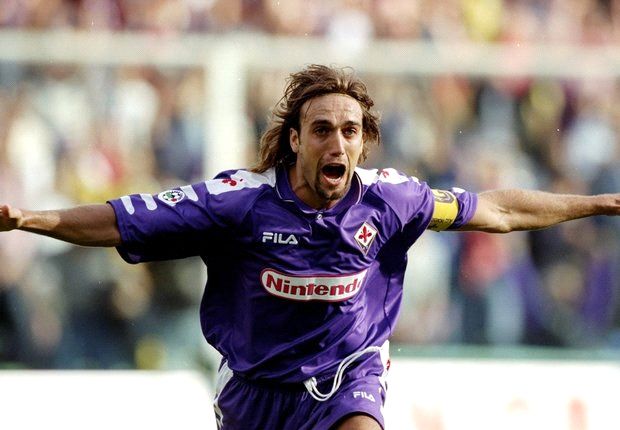
Gabriel Omar Batistuta (Spanish pronunciation: [ɡaˈβɾjel ˈomaɾ βatisˈtuta]; born 1 February 1969), nicknamed Batigol [batiˈɣol] as well as El Ángel Gabriel [el ˌaŋxel ɣaˈβɾjel] (Spanish for Angel Gabriel), is a retired professional footballer. The prolific Argentine striker played most of his club football at Fiorentina in Italy, and is the eleventh top scorer of all-time in the Italian Serie A league, with 184 goals in 318 matches.
At international level, he is Argentina's all-time leading goalscorer, with 56 goals in 78 matches, and he played at three World Cups. In 1999, Batistuta was third in the FIFA World Player of the Year awards. In 2004 he was named by Pelé in the FIFA 100 list of the world's greatest living players. A quick, powerful player with an all-round game, good technique, clinical finishing, as well as accurate heading and free-kick taking abilities, he is known as one of the most complete and prolific strikers of his generation. Diego Maradona stated that Batistuta is the best striker he has ever seen play the game.
When his club Fiorentina was relegated to Serie B in 1993, Batistuta stayed with the club and helped it return to the top-flight league a year later. A popular sporting figure in Florence, the Fiorentina fans erected a life-size bronze statue of him in 1996, in recognition of his performances for Fiorentina.He never won the Italian league with Fiorentina, but when he moved to Roma in 2000, he finally won the Serie A title to crown his career in Italy. He played his last season in Qatar with Al-Arabi before he retired in 2005.
Batistuta is of Italian ancestry. Gabriel Batistuta was born on 1 February 1969, to slaughterhouse worker Omar Batistuta and school secretary Gloria Zilli, in the town of Avellaneda, province of Santa Fe, Argentina, but grew up in the near city of Reconquista. He has three younger sisters, named Elisa, Alejandra, and Gabriela.
At the age of 16, he met Irina Fernández, his future wife, at her quinceañera, a rite of passage on her 15th birthday. On 28 December 1990, they were married at Saint Roque Church. The couple moved to Florence, Italy, in 1991, and a year later their first son, Thiago, was born. Thanks to good performances in the Italian championship and with the Argentine national team, Batistuta gained fame and respect. He filmed several commercials and was invited onto numerous TV shows, but in spite of this, Batistuta always remained a low-profile family man.
In 1997, Batistuta's second son, Lucas, was born, and a third son, Joaquín, followed in 1999. He now has a fourth son Shamel. In 2000, Batistuta and his family moved to Rome, where he played for Roma. Two years after Shamel was born, Batistuta was loaned to Inter. In 2003, after 12 years in Italy, the family moved to Qatar where Batistuta had accepted a lucrative celebrity playing contract with a local team, Al-Arabi.
Batistuta ended his career at Al-Arabi, retiring in March 2005, after a series of injuries that prevented him from playing. Soon afterwards he moved to Perth, Australia. In April 2006, the city's established A-league franchise, Perth Glory was put up for sale however Batistuta was not interested in the purchase seeing no real potential in the club.
After retiring he moved to Perth, Australia, but moved back to Argentina in 2007. Despite having completed his coaching badges in Argentina, he currently has no involvement with football, instead he prefers to play polo and golf, he was quoted saying 'I don't like football, it's only my job'. Speaking in a television interview in Argentina, Batistuta said the pain suffered in his ankles after retiring in 2005 became so intense that he "urinated in bed with the toilet only a few steps away. I couldn't move." He visited a doctor he knew asking his legs be amputated, but the doctor turned down his request. He expressed an interest in coaching Australia's national team and Argentina's team. During the 2006 FIFA World Cup he worked as a commentator for Televisa Deportes. Batistuta currently runs his own construction company in Argentina. He also worked as technical secretary in the professional football club Colón, joining the club's staff in January 2012, and leaving at the end of the 2012–13 season. Batistuta is a Roman Catholic.
Marcos Evangelista de Morais (born 7 June 1970), known as Cafu [kaˈfu], is a Brazilian former professional footballer. He is the most internationally capped male Brazilian player and also made history playing for São Paulo, Roma and Milan. He is the only player to have appeared in three World Cup finals, winning two, 1994 and 2002.
Cafu is best known for his time at Roma and Milan. He is regarded to be one of the greatest fullbacks ever to grace the Serie A, and as one of the greatest Brazilian players of his generation. In 1994, he was named South American Footballer of the Year, and in 2004, he was named by Pelé one of the 125 Greatest Living Footballers at a FIFA Awards ceremony. Cafu was a dynamic and energetic right-sided full-back or wing-back, and he is mostly remembered for his great pace, stamina, tactical intelligence, and technical ability, as well as his discipline and his characteristically cheerful demeanour
Early life
One of six children, Cafu was raised in the Jardim Irene favela of São Paulo. At the age of seven, he was able to attend a football academy and soon moved up to the junior sides of Nacional-SP, Portuguesa and Itaquaquecetuba. He also played futsal for two years.
In the early 1980s he was rejected from the youth squads of Corinthians, Palmeiras, Santos, Atlético Mineiro, and Portuguesa. It was not until 1988 that he made the youth squad of hometown club São Paulo, and subsequently won the Copa São Paulo youth tournament that year, but he warmed the bench the next season as São Paulo won the 1989 Campeonato Paulista.
Club career
It was during this time, however, that São Paulo youth coach Telê Santana became Cafu's mentor. He suggested that Cafu move from the midfield to wingback, a spot into which Cafu made the transition with ease despite never previously playing the position. He had soon anchored onto the first team, as São Paulo won back-to-back Copa Libertadores and World Championships in 1992 and 1993. In 1994, he was named the South American Footballer of the Year. Cafu began the 1995 season with Brazil squad Juventude but finished in Spain with Real Zaragoza, winning the 1995 Cup Winners' Cup with the latter.
After a brief stint back in Brazil with Palmeiras in 1996, Cafu returned to Europe once again the next year, this time with Roma, and won the Scudetto in 2001, followed by the Supercoppa Italiana. It was during his tenure at Roma that Cafu earned the nickname Il Pendolino ("The Express Train" or "The Commuter"). Despite making the Coppa Italia final in 2003 with Roma, he moved to Milan after turning down a move to Japan with Yokohama F. Marinos. With the Rossoneri, he won his second career Scudetto in 2004, followed by his second Supercoppa Italiana, and he played in his first UEFA Champions League final in 2005.
Cafu playing for Milan Despite his success with Milan, he continued to hold fond memories of his Roma years, and it was for that reason that on 4 March 2007 – the day after Milan eliminated Celtic in the first knockout round of the 2006–07 UEFA Champions League – he candidly revealed in a UEFA.com chat that he did not want Milan to be drawn against the Giallorossi in the quarterfinal round. He got his wish, as Milan were drawn against Bayern Munich. Milan's successful Champions League campaign saw Cafu finally pick up a long-awaited winners' medal, in a rematch of the 2005 final.
Cafu signed a contract extension in May 2007 that would keep him with Milan until the end of the 2007–08 season, during which he won another UEFA Supercup, and the first FIFA Club World Cup of his career. On 16 May 2008, it was announced that Cafu and compatriot Serginho would be leaving Milan at the end of the season. In Cafu's last game of his Milan career, and maybe his footballing career, he scored a goal in their 4–1 victory over Udinese. Milan's vice-president Adriano Galliani has opened the doors to him to return to work for the club.
He is one of eleven members of Hall of Fame of A.S. Roma.
Passport controversy
Cafu was accused along with several other Serie A players, including Roma team-mate Fábio Júnior and Gustavo Bartelt, countryman and later Milan team-mate Dida, for using forged passport in their attempt to dodge regulations regarding the number of non-European players allowed on Italian club rosters. However, the charge was cleared by FIGC as Cafu's Italian passport is real and issued by Italian officials but 13 others including Dida were banned. But Cafu faced another controversy that similar to Juan Sebastián Verón, accused that Cafu's wife, Regina used falsified documents to claim Italian nationality through Italian descent. Cafu acquired Italian nationality through marriage. In 2004, Cafu and Roma president Franco Sensi went to court.
On 12 June 2006, less than 24 hours before Brazil were to begin their 2006 World Cup campaign against Croatia, Rome prosecutor Angelantonio Racanelli called for the imprisonment of Cafu, his wife Regina de Morais, and his agent for nine months following the resurfacing of a false-passport scandal. The very next day, however, Cafu, his wife, and agent were acquitted of all charges.
International career
Cafu playing for Brazil. Cafu is the most-capped Brazilian men's player of all time with 142, including a record 21 World Cup games. He has won two World Cups in 1994 and 2002, as well as being the only player to participate in three World Cup final matches. Cafu also held the record of winning the most number of matches in World Cups with 15 (along with two games Brazil won on penalty kickoffs), before being surpassed by Germany's Miroslav Klose in the 2014 Fifa World Cup.
He earned his first cap in a friendly against Spain on 12 September 1990, and played sparingly for Brazil in the early 1990s, making the 1994 World Cup roster as a substitute. He appeared in the final against Italy, following an injury to Jorginho in the 22nd minute. After that, Cafu was soon a regular in the starting eleven as Brazil won the Copa América in 1997 and 1999, the 1997 FIFA Confederations Cup, and reached the 1998 FIFA World Cup final.
Brazil endured a rocky qualification for the 2002 tournament, during which Cafu came under heavy criticism from coach Wanderley Luxemburgo, who stripped him of the team captaincy after he was sent off in a qualifier against Paraguay. Shortly after that, though, Luxemburgo was out of a job, and replacement Luiz Felipe Scolari made Emerson his new choice for captain. However, Emerson missed the cut after he dislocated his shoulder in training, which allowed Cafu to regain the armband. After Brazil defeated Germany 2–0 in the final match (Cafu's third consecutive World Cup final), he stood on the victory podium during the postmatch celebration and, as he raised the trophy, shouted to his wife, "Regina, eu te amo!" ("Regina, I love you!").
Cafu and Brazil fell short of high expectations placed on the squad four years later in 2006, as Brazil meekly exited in the quarterfinals after a 1–0 defeat by France. Coach Carlos Alberto Parreira was criticized for featuring fading veterans, most notably the 36-year-old Cafu and 33-year-old Roberto Carlos, in the starting eleven in lieu of younger players. Cafu was one of only a few Brazil players who spoke to the press in the midst of a hailstorm of criticism from Brazilian fans and media alike following the team's return home. He nonetheless expressed interest in participating in the 2010 FIFA World Cup; however he did not, as he retired completely from football in 2008.
Cafu was named by Pelé as one of the top 125 greatest living footballers in March 2004. Cafu has been known as the best right back of his generation.